Projekt Fredrika’s Year 2025 – and Sights Set on 2026
Translation from original post in Swedish
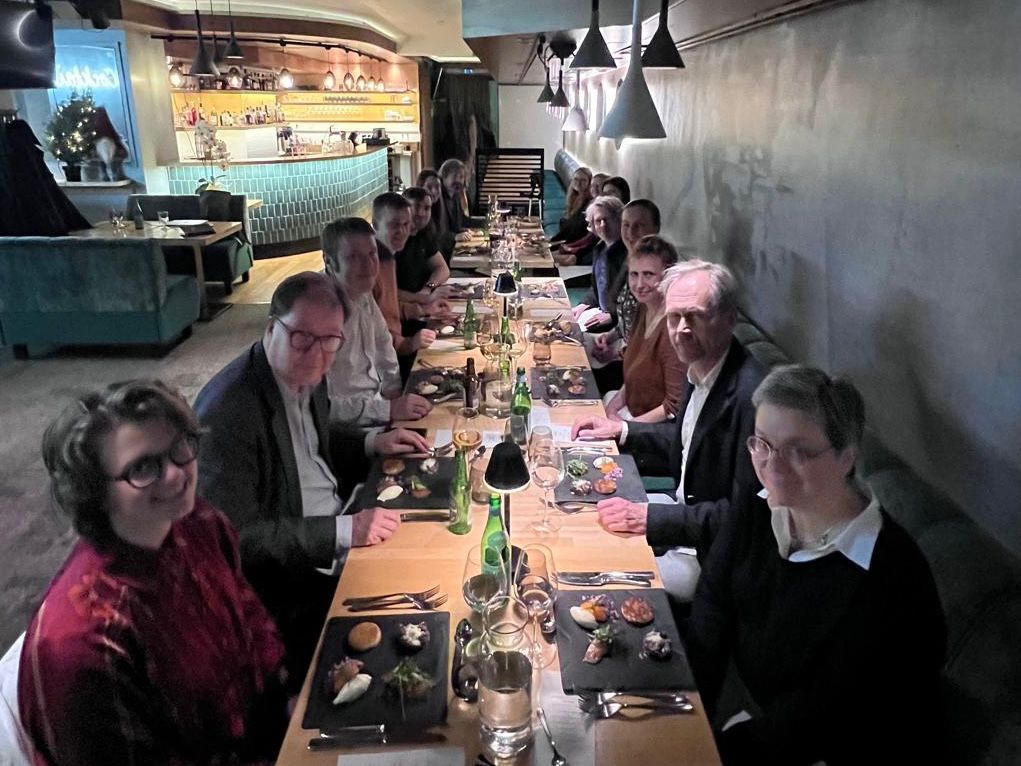
Projekt Fredrika’s inner circle gathered for a Christmas dinner on December 8, 2025 in Tölö, Helsingfors. Board Chairman Kaj Arnö gave the evening’s speech about what we accomplished in 2025, what we learned, and what we’re aiming for in 2026.
Before we share a summary of Kaj’s speech, let us explain what Projekt Fredrika is:
What is Projekt Fredrika?
Projekt Fredrika improves the coverage of Swedish Finland and Swedish in Finland on Wikipedia, in Swedish and other languages. The project is organised through project pages on Wikipedia in a number of languages, and through the registered association Projekt Fredrika rf. For more in English, see en:Wikipedia:Projekt_Fredrika, and even more details in Swedish: sv:Wikipedia:Projekt_Fredrika.
And now for Kaj’s speech:
What We Did in 2025
This year’s work can be divided according to our funders: Svenska kulturfonden, Svenska litteratursällskapet i Finland, and Harry Schaumans stiftelse in Österbotten.
1. Feed the AI Dragon
We received two grants from Svenska kulturfonden. The first assignment was titled “Feed the AI Dragon” (“Mata AI-draken”) – ensuring that ChatGPT, Claude, Gemini, and other LLMs know Swedish-speaking Finland as well as possible. LLMs use Wikipedia and Wikidata as reliable sources of “truth,” information that has been fact-checked by a community.
“Feed the AI Dragon” was simply about improving Wikipedia based on a methodology where we use AI to feed AI. We built tools that suggest Wikipedia edits based on selected sources. This followed Kaj’s presentation in autumn 2024.
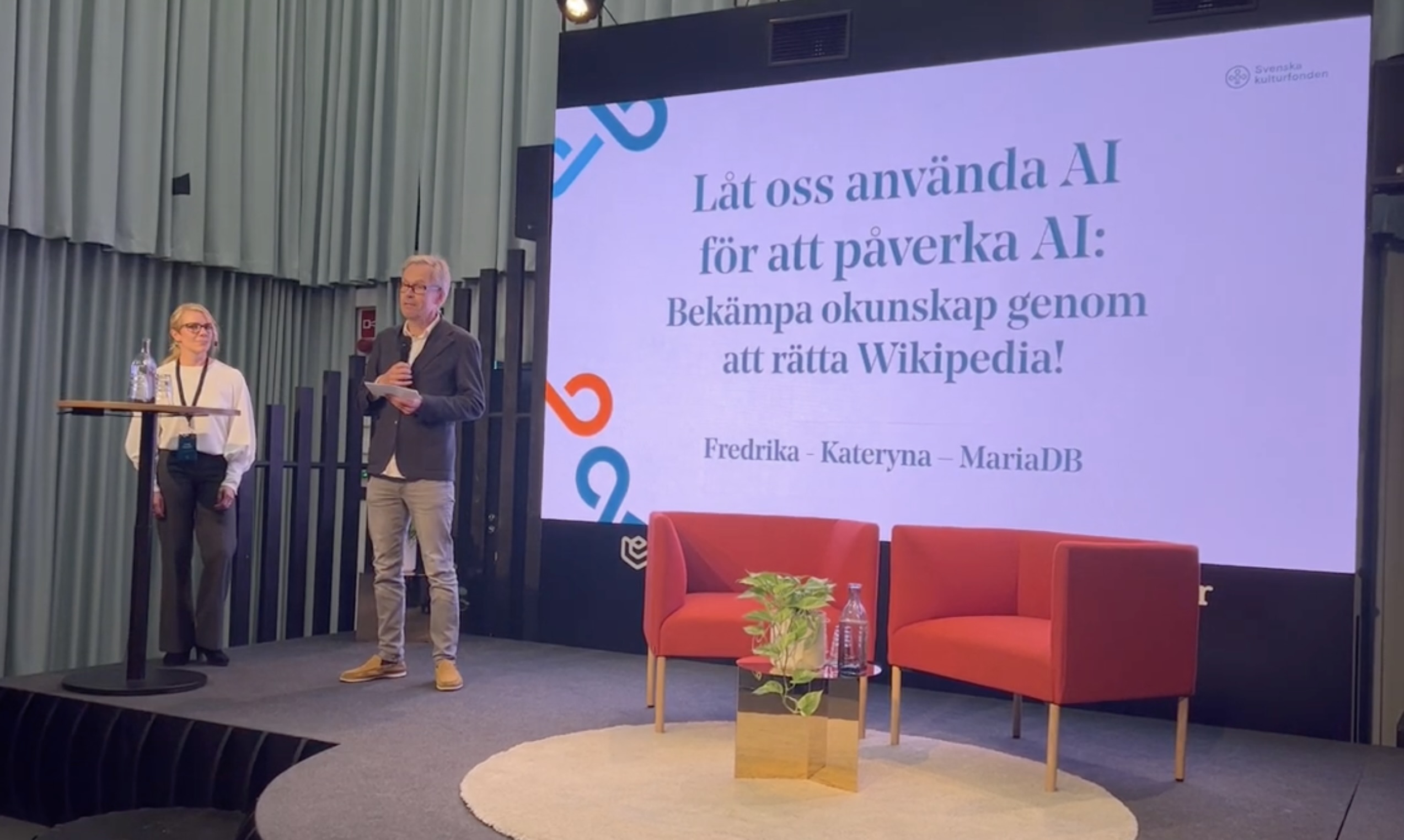
We have been careful to take responsibility: we don’t unleash bots on Wikipedia that update on their own. It’s about semi-automated work steps where we increase our own efficiency as human Wikipedians.
For more details, see the project pages Wikipedia:Projekt_Fredrika/Mata_AI-draken and Wikipedia:Projekt_Fredrika/Yle.
2. The Comedy Group KAJ
When interest in the Finland-Swedish comedy group KAJ exploded in February 2025 (due to KAJ’s victory in Melodifestivalen and becoming Sweden’s entry to Eurovision), we saw a golden opportunity to share Swedish-speaking Finland with an international audience. During Melodifestivalen, readership of KAJ’s Wikipedia articles in Swedish and Finnish increased three hundred-fold, and the Vörå article received ninety times more views.
At the beginning of 2025, KAJ had two modest Wikipedia articles with much potential for improvement. We coordinated with Vörå municipality and received funding from Harry Schaumans stiftelse for the work.
We improved KAJ’s article, created sub-articles for their works (see navbox), added images and pronunciation audio (see commons), and improved related articles like Vörå and Finland-Swedish music (see navbox). The Wikipedia community created a total of 30 language versions of the KAJ article before Eurovision – we hope they became better thanks to the significantly improved content we made available in the Swedish, Finnish, and English versions.
For more details, see our KAJ blog and the project page Wikipedia:Projekt_Fredrika/KAJ.
 Images of KAJ from before Bara Bada Bastu are also available on Wikimedia Commons now – available for use across all Wikipedia languages.
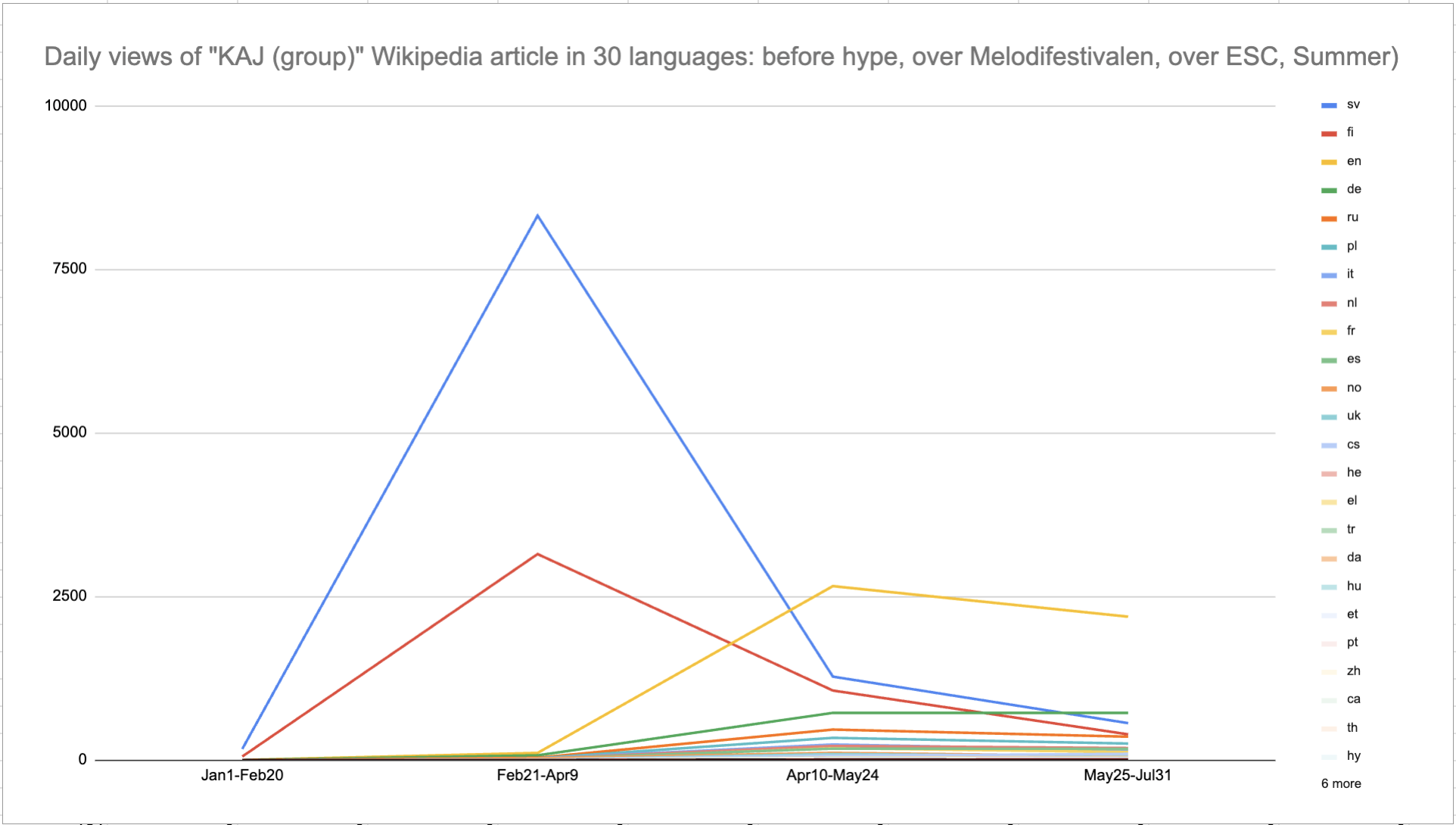 Statistics on KAJ article views: Swedish (blue) and Finnish (red) skyrocketed during Melodifestivalen, while others were created and grew before Eurovision. German (green) views also grew after Eurovision.
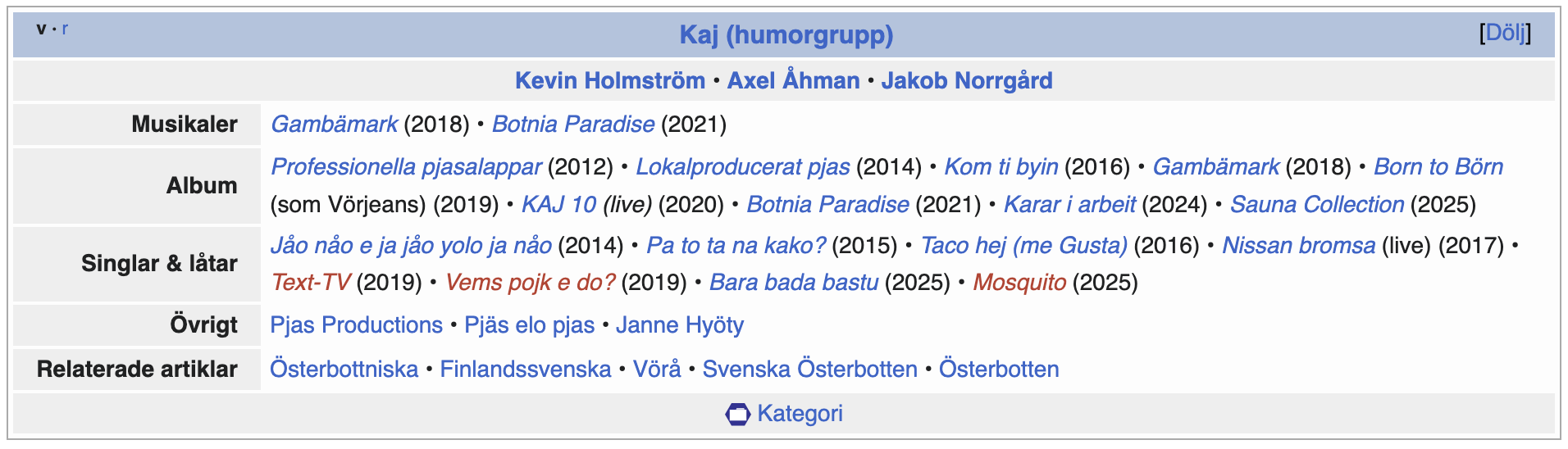 All articles we created about KAJ in Swedish in a navbox we created for navigating between them.
3. Finland’s Authors
With Svenska litteratursällskapet, we work in “packages,” four per year. This year, all of them were about the book series Finlands författare (Finland’s Authors) – three volumes with a total of over 6,600 authors active 1809–1916, 1917–1944, and 1945–1980 – published in 1981, 1985, and 1993.
The work had two phases. First, we prepared the scanned material and created the Wikidata backbone with traditional IT (Python scripts). Over 4,200 authors were linked to Wikidata objects – the most relevant authors regardless of Finnish or Swedish language, with birth dates and multiple lines of content in the book.
The second phase was about updating the authors’ Wikipedia articles with text content, primarily in Swedish but also in Finnish and English. We prioritized according to Wikipedia reading statistics, length in the book, and relevance to Swedish-speaking Finland.
With the tool Lovable, we built a tool that AI-generates improvement suggestions. It fetches the Wikipedia article and the book’s content, suggests additions, and generates an improved article that you review before publishing.
As an aside: The Swedish startup Lovable is the fastest-growing company ever – it has achieved 100 million euros in ARR in the shortest time ever.
For more details, see the project pages Wikipedia:Projekt_Fredrika/SLS-Författare-1809, SLS-Författare-1917, and SLS-Författare-1945, as well as the code at github.com/projekt-fredrika/sls-forfattare.
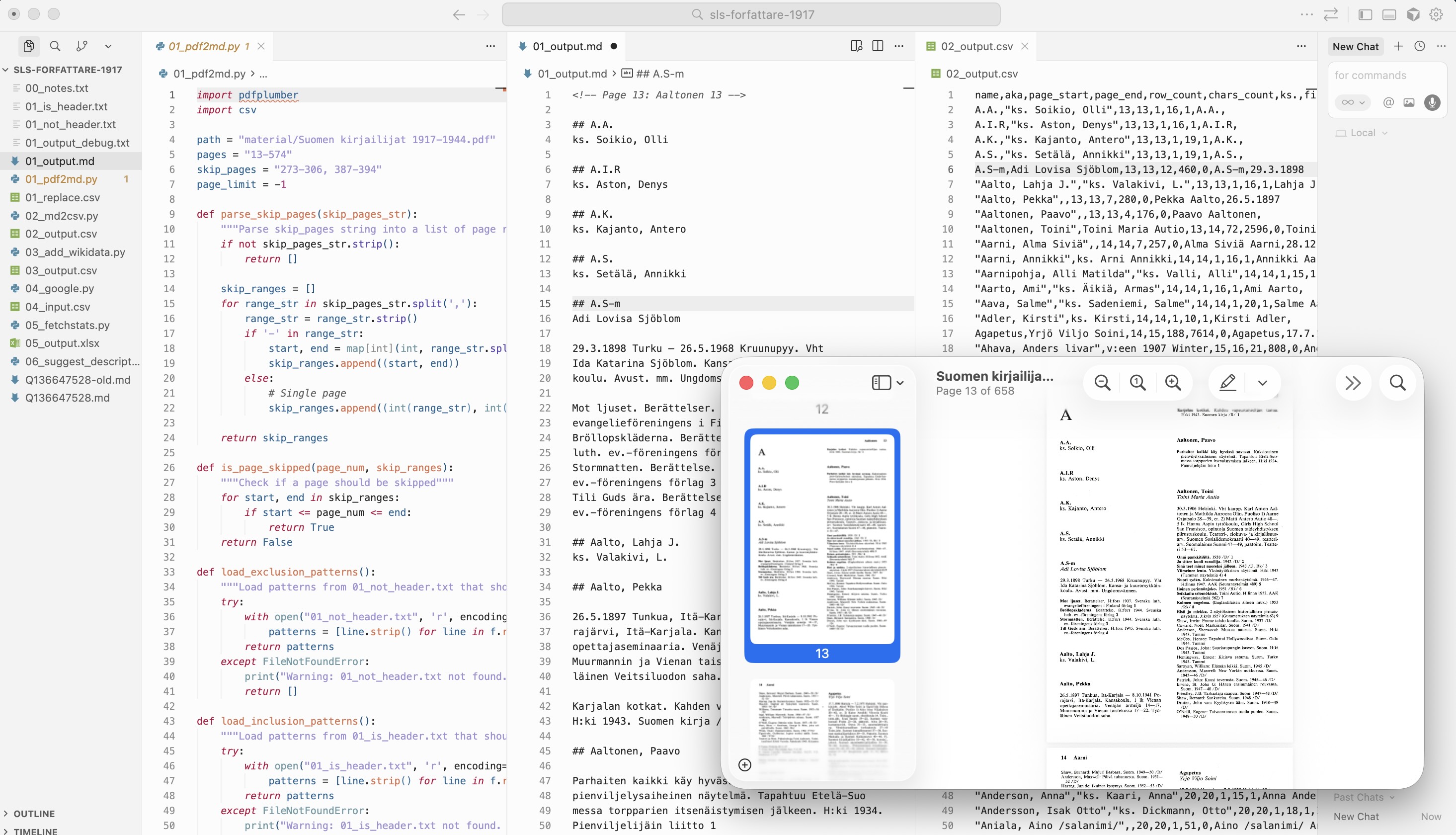
Preprocessing in Cursor with AI-generated “traditional IT” Python code: converts scanned PDF in the foreground to structured data in the background.
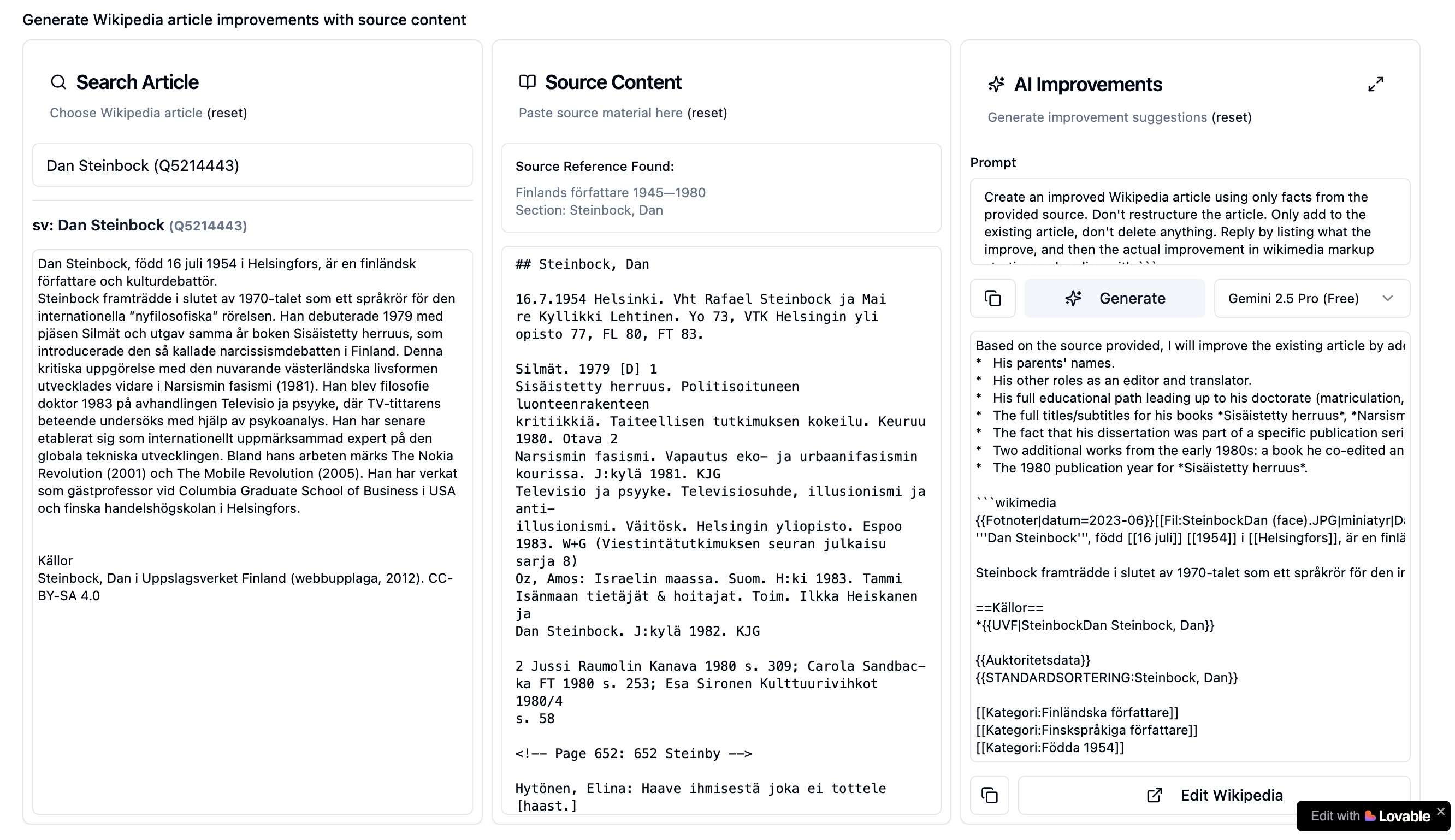
Lovable tool for generating improvement suggestions: current Wikipedia article on the left, source in the middle, and AI-generated improvement suggestion on the right.
4. SuRu and Wikidata
The second grant from Svenska kulturfonden was different: improving Wikidata lexemes with Stora finsk-svenska ordboken (SuRu, The Large Finnish-Swedish Dictionary). We got the idea from having previously entered dialect words from Ordbok över Finlands svenska folkmål (Dictionary of Finland-Swedish Dialects) in collaboration with Institutet för de inhemska språken (Institute for the Languages of Finland).
Reflecting the entire dictionary in Wikidata’s lexeme structure is overwhelming – the book has over 100,000 entries. We chose two areas: the most common lookup words according to Google Analytics, and Finland-specific words marked “Suom” in the dictionary (e.g., bergsråd/mining councillor). A difficult and interesting assignment with complicated Wikidata structures.
For more details, see the project page Wikipedia:Projekt_Fredrika/Suru and the code at github.com/projekt-fredrika/kotus-suru.
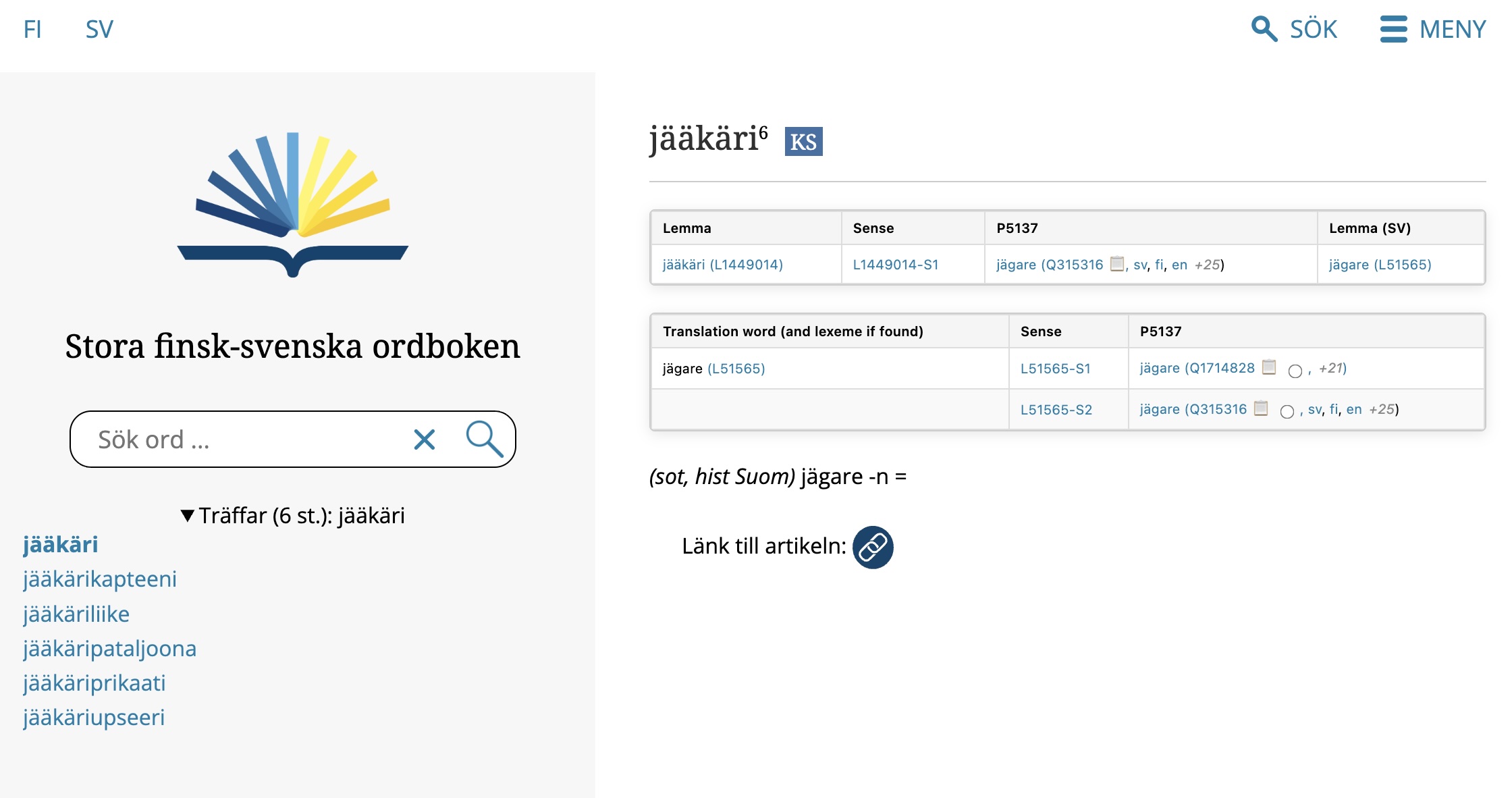
The word jääkäri is marked in SuRu with “hist Suom” due to the word’s Finland-specific meaning. In the screenshot, you can also see a tool we developed to show the SuRu word’s corresponding lexeme in Wikidata – which facilitates linking translations in Wikidata.
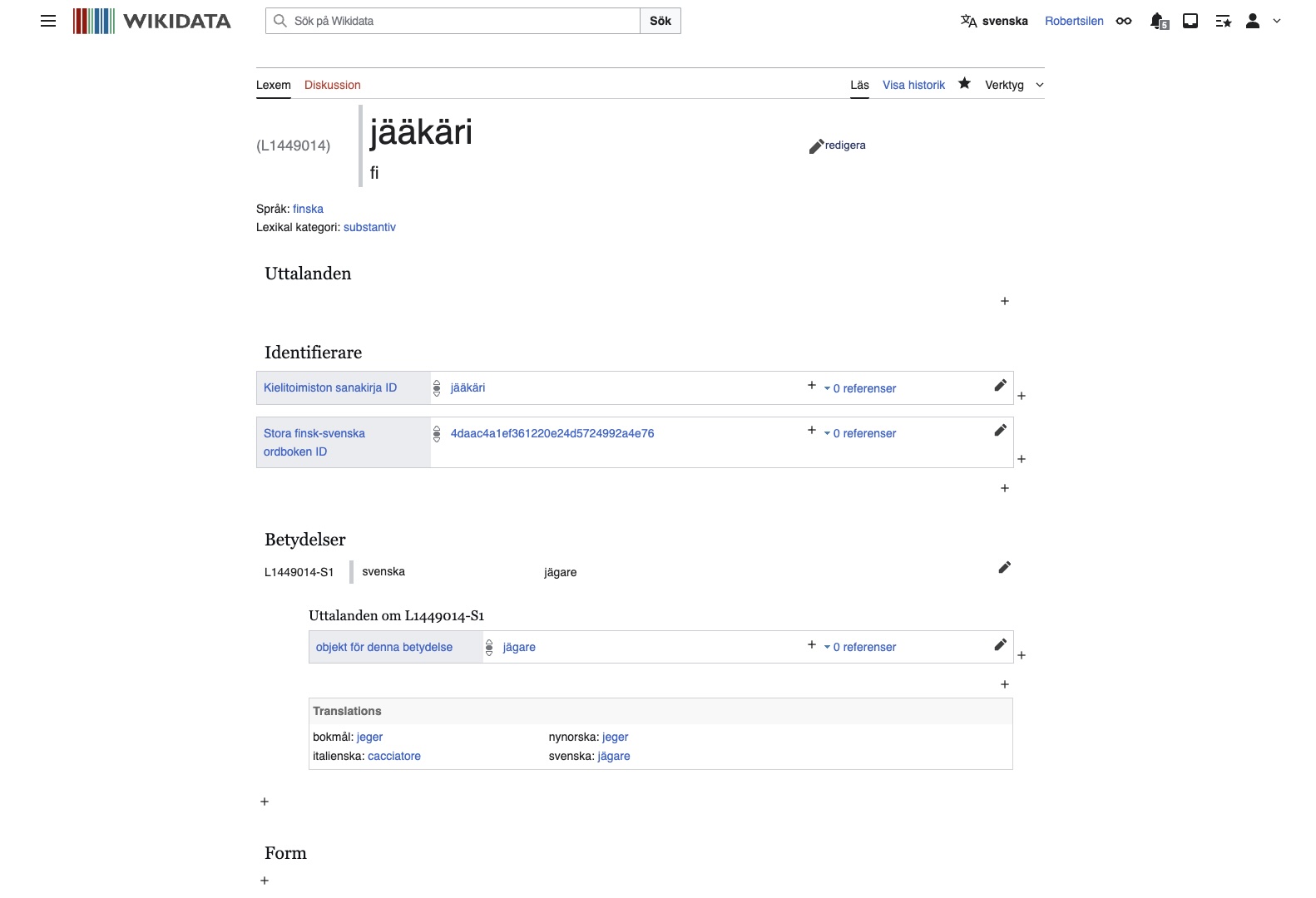
The Finnish “jääkäri” lexeme in Wikidata has code L1449014. The translation is the Swedish “jägare” lexeme’s second sense, see L51565#S2.
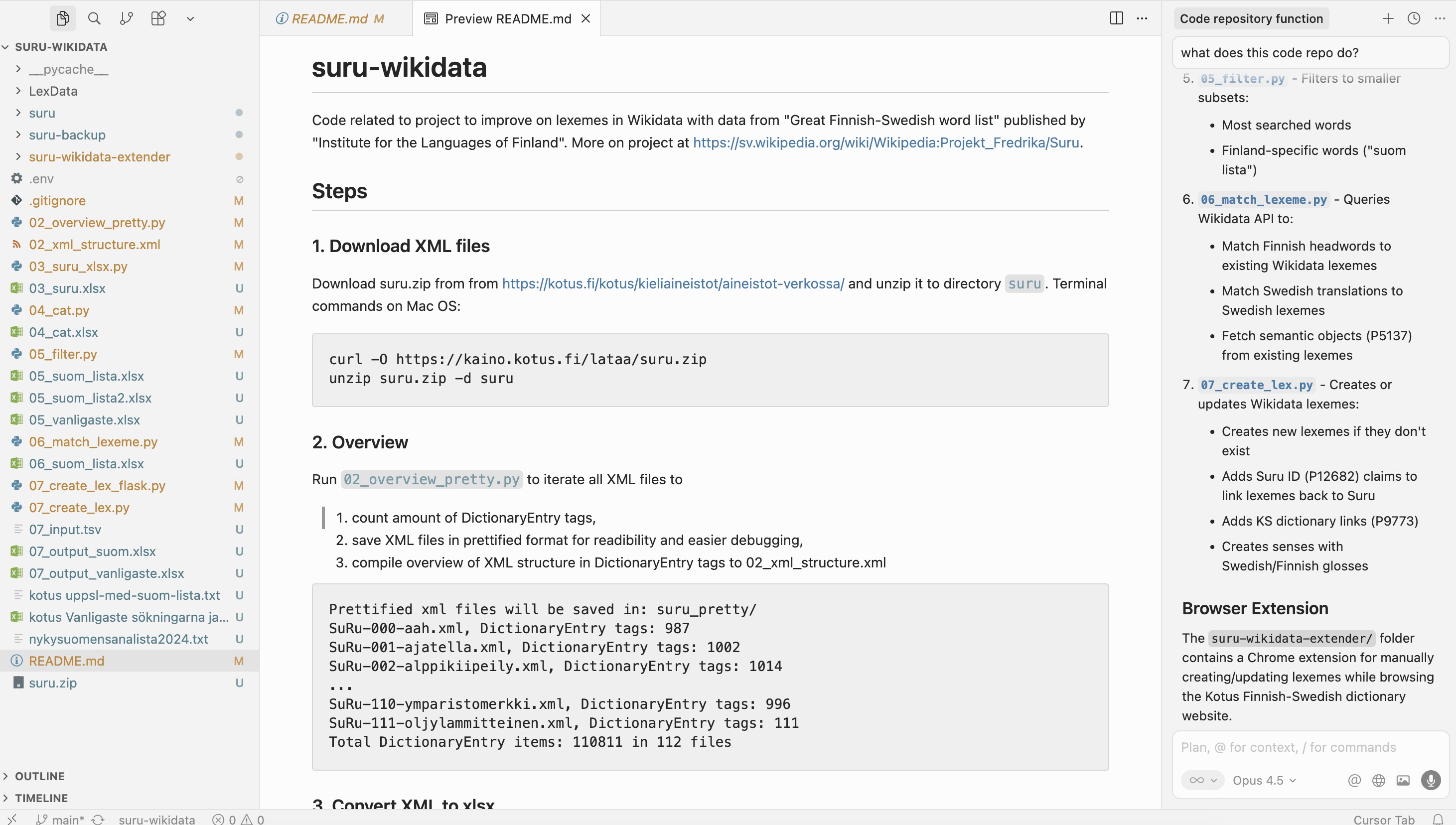
The Python scripts we created with Cursor to adapt SuRu’s XML files to Wikidata lexemes.
What We Learned in 2025
1) AI Makes Us Productive
With tools like Lovable and Cursor, the work process has gone from entirely manual to partially automated. When the tools always go through the same steps, the result becomes more consistent and reliable. There was a time when Robert came to Kaj with difficult programming questions – now he powers through with the help of AI.
2) Deeper Wikidata Knowledge
We used Wikidata as the backbone in the author packages, entered KAJ’s musicals and songs so they’re available in more languages, and applied complicated structures for SuRu’s lexemes.
3) Lessons from MariaDB
Both Kaj and Robert work for MariaDB, where we learned about 1) AI embeddings that enable semantic search without LLMs, and 2) hackathons that could be applied like large edit-a-thons within Wikipedia.
Things We Didn’t Fully Achieve
4) From High School Students to University Collaboration
We work successfully with part-time high school students but want to expand to university students and researchers. There’s potential to compare Wikipedia with academic research or between language versions – for example, Kagalen (the Cabal) is described differently in Swedish and Finnish. During the SLS 140th anniversary, we made contact with Henrika Tandefelt, history professor at Helsingfors University.
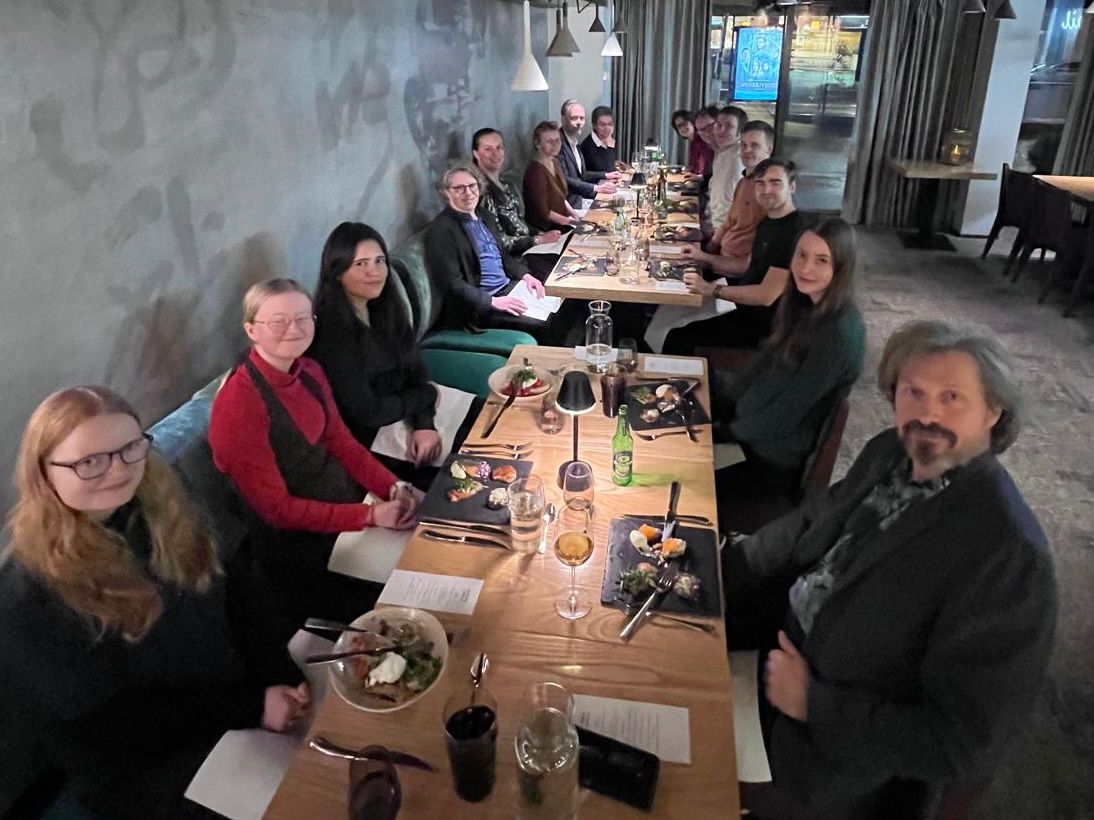
In the foreground are Projekt Fredrika’s part-time and summer workers (plus auditor) at the 2025 Christmas dinner.
5) KAJ and Local Forces
The project could have benefited from more local help. The people of Vörå transported a sauna to Eurovision in Switzerland, but we didn’t manage to create the Wikipedia engagement we had hoped for regarding local knowledge and photography.
6) Stopped Saving the World with Projekt Kateryna
A couple of years ago, we started Projekt Kateryna, which would do for Ukraine what Fredrika does for Swedish-speaking Finland. Despite local interest in Ukraine and our own efforts to generate interest in the West, we failed to find suitable funding within the Western world. We believe the wars in 2008 in Georgia and in 2014 and 2022 would never have occurred if not for all the ignorance about Ukraine and about Russia’s colonial oppression – ignorance that should be patched up by now at the latest.
See Kaj’s presentation in London on YouTube: Saving the World by feeding the AI Dragon with unbiased open data / Kaj Arnö @ SOOCon25 London. The project’s website lives on at projektkateryna.netlify.app.
What Do We Want to Do in 2026?
SLS: Biografiskt lexikon and More
We plan to continue with Biografiskt lexikon för Finland (blf.fi) in at least two packages. We also want to do “edit parties” from more SLS books – take literary texts and reflect them on Wikipedia. Among other things, we’re aiming at books about Westermarck and Finland-Swedish Antifascism.
Svenska kulturfonden: Feed the AI Dragon 2
We have applied for funding for an updated 2026 version of the report “Swedish-speaking Finland on Wikipedia” from 2020. With AI, we can do it faster and more comprehensively. And above all: we want to identify the gaps – which parts of Swedish-speaking Finland are poorly covered?
English Articles
AI trains heavily on English-language material. Therefore, Swedish-speaking Finns who have in one way or another influenced world history – Westermarck, Nordenskiöld, Alma Pihl – should have proper English Wikipedia articles. It’s about being visible where AI models get their knowledge.
Nationalbiblioteket and Forum
Forum för ekonomi och teknik is a goldmine for Finland-Swedish economic history. And Nationalbiblioteket (the National Library) is digitizing old newspapers. Both of these sources should be incorporated into open data.
Forward
There is much left to do. But 2025 has shown that AI is a powerful ally in the work of making Swedish-speaking Finland visible online. As long as there is digital material to start from, we can in a completely different way than before bring knowledge into Wikipedia and Wikidata.
Projekt Fredrika förbättrar täckningen av det svenska i Finland på Wikipedia, främst på svenska men också på andra språk. Läs om oss på Wikipedia (Projektsidan, Project page, Projektisivut, Projektseite, Page du projet, страница проекта, eller följ oss på Twitter, Facebook, Instagram, eller Youtube.